TEM Explainer Series: A New Data Center Doesn’t Just Draw Power. It Can Redraw the Grid
In the first two installments of this series, we followed the money behind an electricity bill and explained how steady data center demand has the potential to lower average costs by using spare generating capacity.
But what happens when a data center increases energy demand enough to require new power plants, transmission lines or substations? The outcome depends on where the facility is built, who pays for its infrastructure, and how flexibly it uses electricity.
Old industrial sites offer a head start
One way to reduce the need for entirely new infrastructure is to build where heavy industry previously operated.
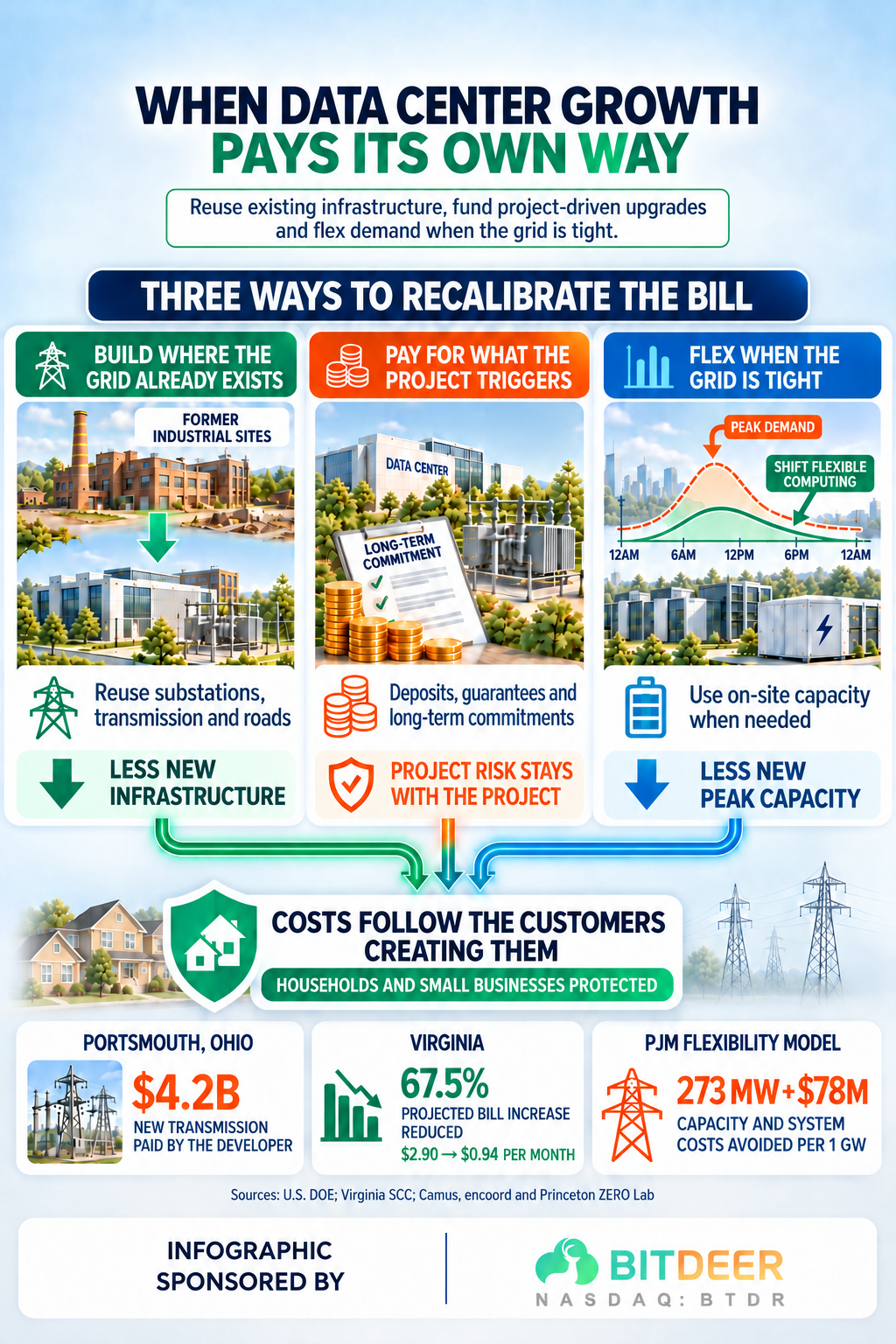
Former factories, mills and power plants may already have industrial zoning, transmission connections, substations and roads. A developer may therefore be able to reuse part of an existing industrial platform.

This opportunity is significant across the United States, particularly in the Midwest. According to U.S. Energy Information Administration (EIA) data, the amount of electricity sold to industrial customers declined by about 32% in Ohio, 23% in Michigan and 10% in Indiana between 2000 and 2025.
For instance, SB Energy is developing an AI data center campus at a former uranium-enrichment facility in Portsmouth, Ohio, combining industrial revitalization with protections for electricity customers. The U.S. Department of Energy says the developer has committed to support site cleanup and pay for $4.2 billion of new transmission infrastructure.
Other projects follow variations of this model. Pennsylvania’s former Homer City coal plant is becoming a 3,200-acre power and data center campus. A planned 1.8-gigawatt AI campus at Kentucky’s former Paducah uranium-enrichment site is slated to include new gas-fired generation, battery storage and transmission upgrades.
New funding models: letting new demand underwrite the grid
Even at a well-connected site, a large data center may require grid upgrades. However, who pays is not always immediately clear or predetermined.
Utilities often recover infrastructure costs through charges spread across their many customers over time. That means if an asset is primarily built for one large customer, households and small businesses could end up paying for infrastructure upgrades they did not expressly cause based on existing retail cost recovery mechanisms.
With these concerns in mind, new rate structures address that price risk for households and small businesses by requiring major developers to support the development of new grid infrastructure. This is completed through upfront contributions, minimum-demand guarantees, and long-term commitments.
Major technology companies have backed this approach in North Carolina. On October 7, Duke Energy (NYSE: DUK) announced a settlement with the state’s consumer advocate, Amazon, Google, Meta, Microsoft and others that would require digital infrastructure projects to pay to connect to the grid.
If approved by state regulators, the agreement would require qualifying large customers to make nonrefundable upfront payments for infrastructure built exclusively for them, such as dedicated substations. For shared upgrades, including transmission lines, customers would provide deposits and financial guarantees. They would also pay for electricity under a separate rate structure designed for large users.
Virginia provides another example. Regulators have changed how Dominion Energy (NYSE: D) Virginia allocates transmission costs and allowed it to charge large customers for facilities built specifically to connect them. Qualifying customers now face minimum transmission charges and service commitments of at least 14 years.
The Virginia State Corporation Commission estimated that the revised allocation would reduce typical residential customers’ projected monthly increase by 67.5%, from $2.90 to 94 cents.
Such arrangements give developers a clearer picture of their connection costs and help utilities fund upgrades by securing payment commitments. Predictable rules also help protect households and small businesses from being left with the bill if a project does not go ahead.
New usage models: using the grid more efficiently
We previously discussed how fixed or steady demand can use spare capacity, potentially lowering prices. Flexible connections apply the same idea at a more granular operational level.
A data center may be able to shift demand during periods of grid stress. Some computing can be rescheduled, moved to another facility, or temporarily supported by on-site resources.
It is like asking heavy trucks to avoid rush hour. If enough traffic moves to quieter periods, another lane may not be needed.
A recent study modeled this approach in the PJM power market. It estimated that limited flexibility – allowing some demand to be reduced at critical times – at a one-gigawatt data center could avoid the need for 273 megawatts of new generating capacity and about $78 million in system costs.
If the facility also supplied its own capacity while paying its normal electricity charges according to a minimum demand profile, those contributions could cover nearly all the modeled system costs created by its demand.
While direct results will depend on location, operations, backup resources, and contracts, the study shows why a data center’s maximum demand will not always become the grid’s permanent planning target.
The bottom line: Growth can pay its own way
Greater grid demand does not automatically require increased electricity bills for customers.
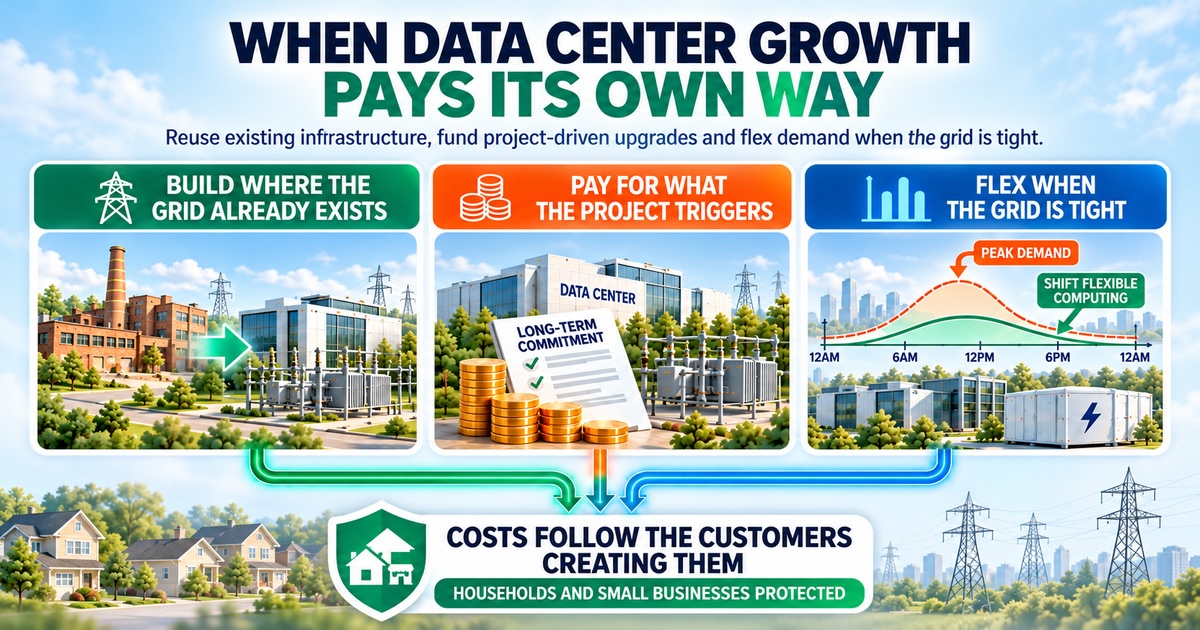
Industrial sites can provide a head start. Long-term commitments can underwrite investment. Dedicated payments can keep project costs with the project, while flexibility and the right site can reduce required infrastructure.
The question is not simply how much electricity a data center uses. It is whether the project is located, financed and operated in a way that supports the grid—without passing its bill to others.