The Promise
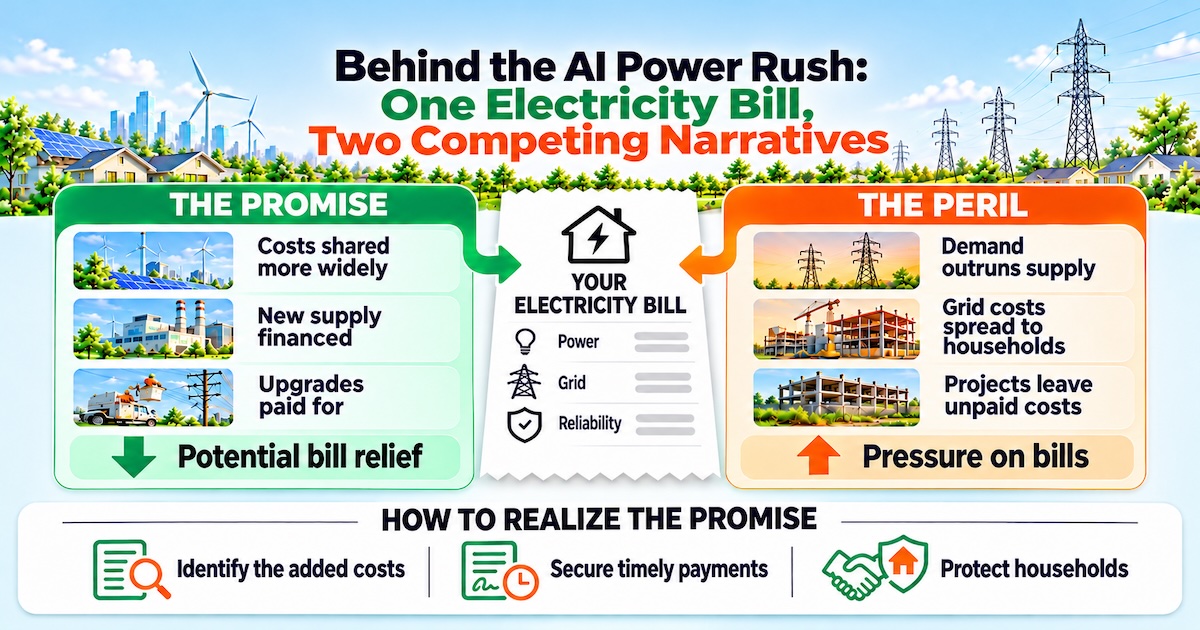
A large, steady customer can help pay for infrastructure that households already support. Power plants, substations and transmission lines have substantial costs whether they are fully used or partly idle. When a data center uses spare capacity, its payments can spread those costs across more electricity sales.
It is much like filling empty seats on a bus that is already running. More passengers contribute to the journey without necessarily requiring another vehicle.
A long-term buyer can also give a power supplier the confidence to invest in additional generation. And when a data center pays for the grid upgrades it needs, the system can expand without asking households to finance that customer’s connection.
Together, these arrangements offer a route to a stronger grid and potential bill relief: existing assets work harder, new supply has financial backing, and the customer driving an expansion helps fund it. The promise depends on those revenues covering the costs the project adds.
The Peril
The difficulty begins when the new customer arrives before the system is ready.
A data center may need electricity well before a new power plant or transmission line can provide it. Its demand joins everyone else’s in the meantime. Spare capacity becomes scarce, and securing supply becomes more expensive.
PJM’s auction pays suppliers to keep power available in a future year, separately from the electricity they actually produce. Those capacity payments feed into retail bills. Falling short of a reliability target means a thinner safety cushion, rather than inevitable blackouts, but costs can rise before any shortage materializes.
PJM’s independent market monitor estimated in its 2025 annual report that existing and forecast data-center demand added a combined $16.6 billion to capacity-market revenues across the 2025–2026 and 2026–2027 auctions. That is a modeled comparison, not a household surcharge; the effect on individual bills varies.
Building more infrastructure brings a different expense. The initial plan to serve Meta’s Louisiana campus called for three gas plants totaling 2,262 megawatts, alongside transmission upgrades—more than $3 billion of infrastructure. Regulators added consumer protections, while critics questioned customers’ remaining exposure.
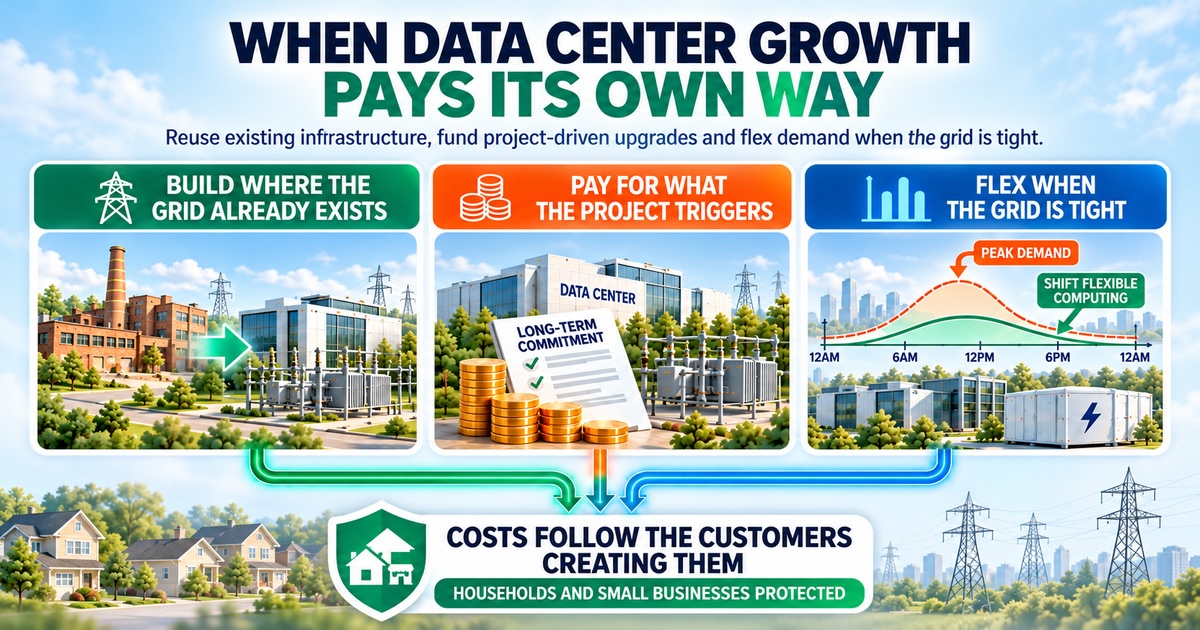
Paying for electricity inside a data center does not necessarily cover every upgrade outside its fence. A direct connection may be charged to the developer while improvements farther along the network are treated as shared costs.
A Union of Concerned Scientists analysis identified 130 projects in seven PJM states and more than $4.3 billion in data-center connection costs approved in 2024 that it said were being passed to utility customers. These investments are recovered over time, rather than charged entirely to households in one year.
There is another wrinkle: a request for power is not a guarantee that a project will open. Treating every application as certain demand risks planning for customers who never arrive. A crowded queue is not a reliable stopwatch for when viable projects can connect, either.
Texas offers a test of that distinction. In September 2026, ERCOT, the state’s main grid operator, began issuing verification requests under its Batch Zero interconnection process, requiring supporting documents and notarized attestations. Projects that fail to satisfy the requirements are excluded from that process. Such checks matter before construction begins: if expected customers disappear, households could inherit infrastructure costs unless developers’ payment commitments remain binding.
Realizing the Promise
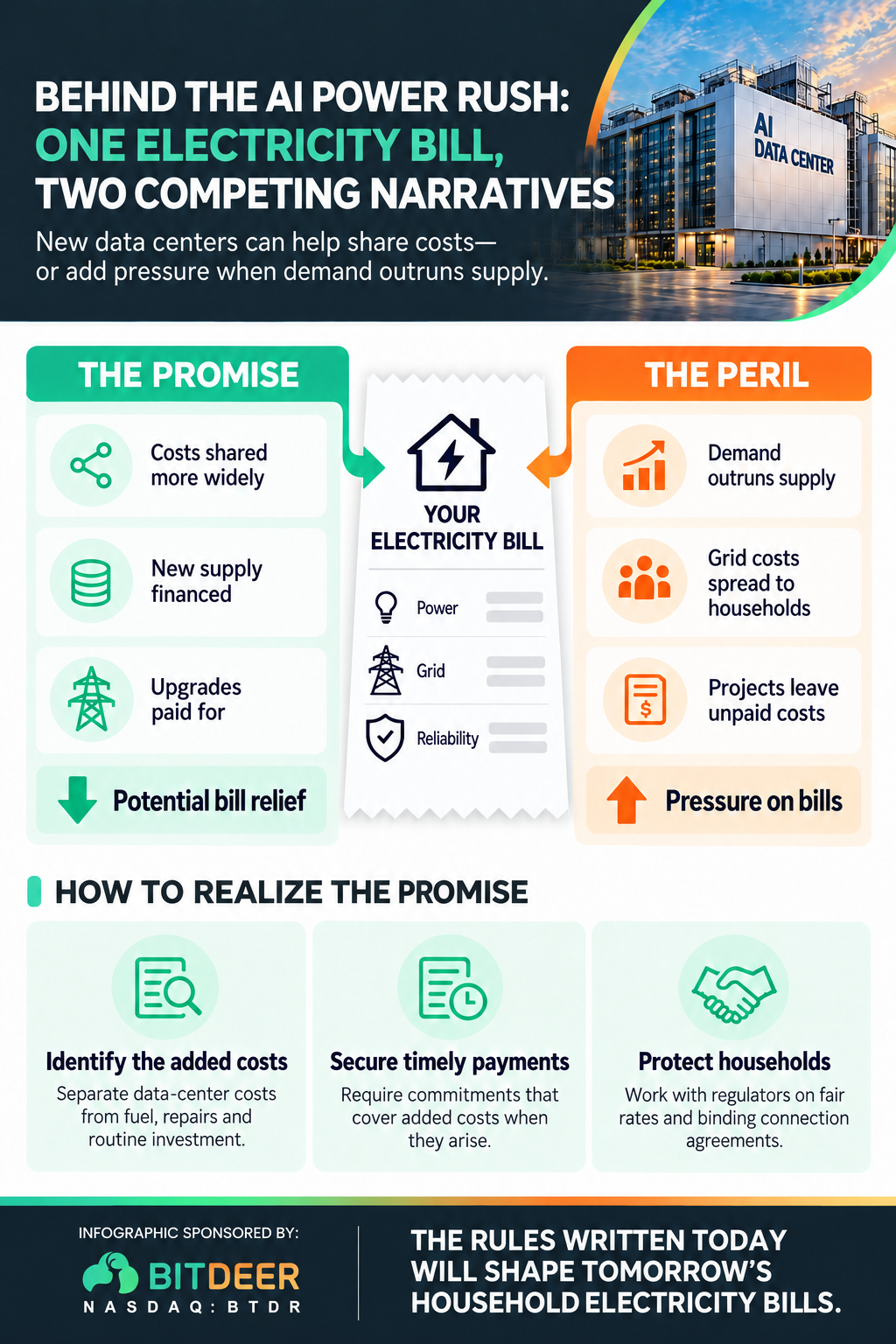
Rising rates alone cannot tell us how much of the increase comes from data centers. That requires separating the costs of serving new customers from fuel costs, repairs, and investment the utility would have needed anyway. A new project may still pay its own way. The question is whether its payments cover the added expense, on a timetable that works for everyone already using the grid.
Those payments need to survive changes in a developer’s plans. In July 2025, Ohio regulators ordered AEP Ohio to establish a special data-center tariff, explicitly addressing the risk that underused investments could become other customers’ responsibility. Minimum payments and financial guarantees help turn a forecast of future revenue into an enforceable obligation.
Large customers also need to work with regulators and grid operators before construction commitments are made. Connection agreements can establish who funds upgrades, when supply will be available, and whether a facility must reduce demand when the grid is strained. PJM’s July announcement described plans to develop such flexible connection arrangements.
The benefits of large-scale digital infrastructure remain attainable. But a promise of future investment offers little comfort to a household facing higher charges today. Keeping electricity affordable for a data center’s neighbors takes accountability: clear costs, timely payments, and protections that remain effective if the project changes.
Across this series, one conclusion has held: the rules being written now in rate cases, capacity auctions and connection agreements will decide whether data centers lower household bills—or raise them.